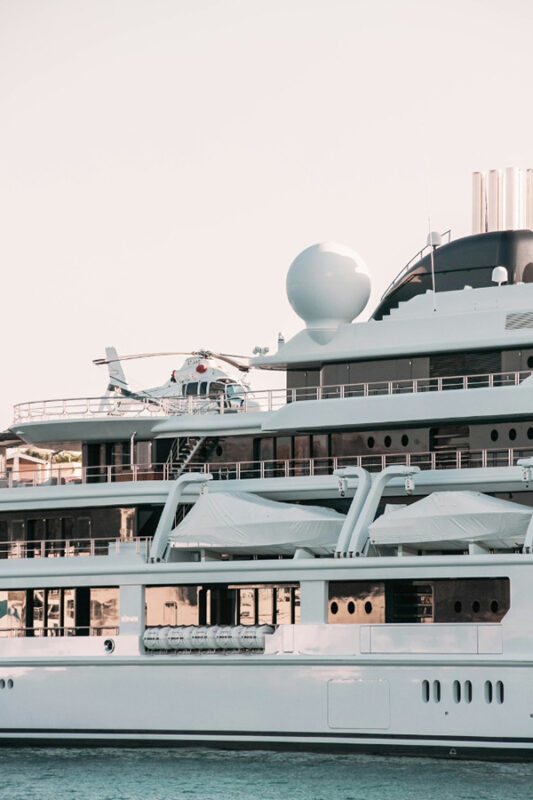


- Knight Frank attributes the superyacht sales recovery to the highest number of new yachts entering the market in seven years, not to a surge in buyers.
- Boats Group’s 2025 Market Index recorded full-year sales roughly 9% below 2024, with stabilisation in the second half and growth returning in the fourth quarter.
- SuperYacht Times counted 6,174 operational superyachts over 30 metres globally by August 2025.
- A market that recovers on supply behaves very differently from one that recovers on demand. Buyers hold the advantage in the first case.
The superyacht market is recovering, and the reason matters more than the fact. Knight Frank’s analysis credits the improvement to an injection of fresh inventory, with the highest number of new yachts entering the market in seven years, and adds a conditional worth reading closely: provided prices remain realistic and inventory is available, the lifestyle appetite of ultra-high-net-worth individuals points to continued activity through 2026. That is a recovery described in terms of supply and pricing discipline rather than in terms of demand. Here is what the data shows and what it means if you are buying.
What the Numbers Actually Say
Three data points frame the current position, and they do not all point the same way.
| Source | Finding |
|---|---|
| Boats Group 2025 Market Index | Full-year sales roughly 9% below 2024, stabilising in H2 with Q4 growth |
| Knight Frank | Recovery aided by the most new inventory entering the market in seven years |
| SuperYacht Times | 6,174 operational superyachts over 30 metres worldwide by August 2025 |
| BOAT International order book | 1,093 yachts of 24m+ on order, down from 1,138, a second annual decline |
Read together: transactions fell through 2025 and turned up late in the year, inventory improved substantially, and new orders continued to decline. That combination describes a market clearing existing stock rather than one commissioning new tonnage.
Why Supply-Led Recovery Favours Buyers
Because the negotiating position inverts. In a demand-led recovery, more buyers chase the same boats, prices firm and sellers set terms. In a supply-led recovery, more boats meet a steady number of buyers, and the leverage moves across the table.
Three practical consequences follow:
- Realistic pricing becomes the condition of sale. Knight Frank makes this explicit. Sellers holding out for boom-era valuations are the ones whose vessels sit.
- Comparable inventory strengthens the buyer’s hand. When three similar boats are available rather than one, survey findings and specification gaps become negotiable rather than academic.
- Time works differently. Buyers can be selective in a way that was impossible in 2021 and 2022, which is a genuine change in how an acquisition should be approached.
The Order Book Tells the Opposite Story
New construction has not followed brokerage. The order book has declined by unit count for a second consecutive year while average length has climbed to a record, which is a market building fewer boats and building them larger.
That divergence is not a contradiction. Brokerage and new build serve different clients and different timelines. A buyer who wants a boat this season shops brokerage. A buyer commissioning a custom vessel is negotiating for delivery in 2028 or 2029, and that decision reflects confidence in a horizon rather than in a season. We set out the full order book picture in the Monaco Yacht Show 2026 fleet.
The practical read is that immediate availability has improved while future capacity has not. Delivery slots at the leading yards still extend toward the end of the decade.
Who Is Actually Buying
The composition of demand has shifted, and it explains why brokerage is moving while new orders are not.
Industry reporting points to a younger, more experience-oriented generation trading status-driven acquisition for long-range cruising, private wellness use and floating residences. That buyer wants a boat now, for use, rather than a three-year commissioning process and a naming ceremony.
Charter has been the entry route for much of this cohort, which is consistent with the pattern across private aviation, where access is preferred to ownership among newly liquid wealth. The same logic is examined in how AI wealth is rewriting service expectations.
What This Means If You Are Buying
- Start from use, not from profile. Range, draft and layout follow from who is aboard and where you cruise. The silhouette should be the last decision, not the first.
- Treat availability as temporary. Seven-year inventory highs are not a permanent condition, and the order book decline means the pipeline behind current stock is thinner.
- Underwrite running costs properly. Purchase price is a fraction of ownership. Crew, berth, maintenance, insurance and refit reserve are the recurring number that decides whether a boat is enjoyable or a burden.
- Watch the regulatory environment. Political risk has entered the Mediterranean conversation, as we covered in the French bill on yachts over 50 metres.
Bottom Line
Superyacht sales are recovering on the back of the most new inventory in seven years, after a 2025 that ran roughly 9% below 2024 and stabilised late. The installed fleet stands at 6,174 vessels over 30 metres while the order book has fallen for a second year, which means immediate availability has improved and future capacity has not. For buyers this is the most favourable set of conditions since before the boom, provided they treat it as a window rather than a new normal. For sellers, the operative word in every piece of analysis this year is realistic. The wider demand picture sits in our read on where the market is looking next.
FAQ
Is now a good time to buy a superyacht?
Conditions are more favourable than at any point since the boom, with the highest new inventory in seven years and analysts explicitly conditioning continued activity on realistic pricing. Buyers have genuine choice and negotiating room. The caveat is that the order book has declined for two consecutive years, so the pipeline behind current stock is thinner than the present availability suggests.
Why are new orders falling while sales recover?
Because they serve different decisions. Brokerage buyers want a vessel for the coming season and are responding to available inventory. New build buyers are committing to delivery in 2028 or later, which requires confidence in a much longer horizon. The two markets can move in opposite directions without contradiction.
How many superyachts are there in the world?
SuperYacht Times counted 6,174 operational vessels over 30 metres globally by August 2025. That figure describes the installed fleet rather than the market: the great majority of those yachts are not for sale in any given year, and annual brokerage transactions represent a small fraction of the total.
What does a superyacht cost to run each year?
A widely used industry rule of thumb puts annual running costs at roughly ten per cent of the purchase price, covering crew, berthing, fuel, insurance, maintenance and a refit reserve. The figure varies considerably with size, cruising pattern and crew count, and underestimating it is the most common error among first-time owners.