

- A private member’s bill filed in the French National Assembly would bar privately operated yachts of 50 metres or more from French ports, berths, anchorages and territorial waters.
- Proposed penalties run from 1% to 15% of a vessel’s estimated value, plus possible confiscation and a five to ten year exclusion.
- Industry figures put French yachting revenues at around EUR 6.1 billion nationally, EUR 2.6 billion in Provence-Alpes-Cote d’Azur alone, supporting roughly 100,000 jobs.
- It is an opposition bill and unlikely to become law. The signal matters more than the text.
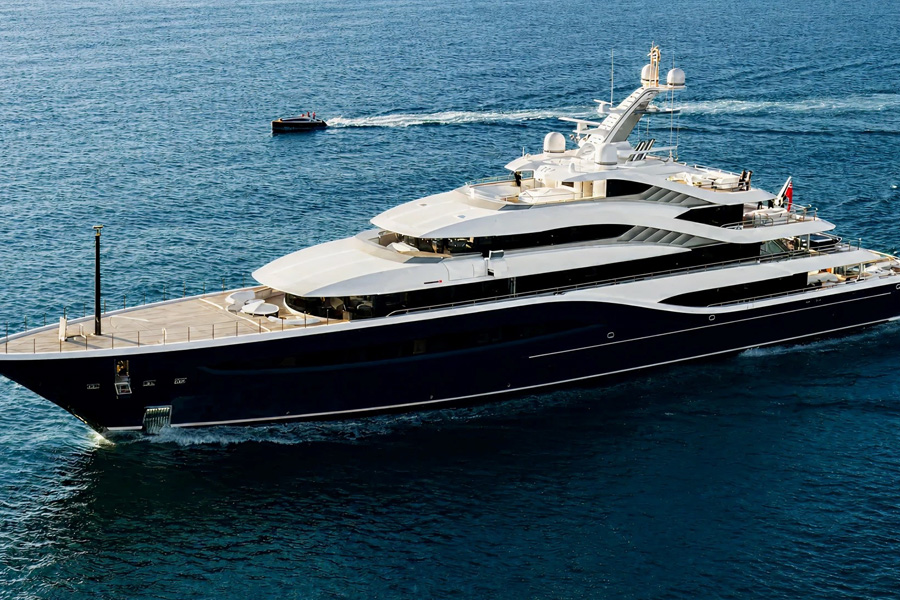
France’s National Assembly has received a bill that would close the country’s waters to superyachts. Proposition de loi number 2968, filed on 23 June 2026 by deputy Thomas Portes and other members of La France Insoumise, would prohibit privately operated pleasure vessels of 50 metres and above from accessing French seaports, using berths, mooring or remaining in territorial waters, with an exemption only for maritime emergencies. The bill comes from an opposition party and is unlikely to pass. That does not make it irrelevant, because owners, brokers and yards now have to price a political risk that did not previously appear on the map. Here is what the text proposes and what it actually changes.
What the Bill Proposes
The mechanism is a blanket exclusion by length rather than by emissions, flag or usage.
- Scope: all privately operated vessels measuring 50 metres or more overall.
- Prohibition: access to ports, mooring, berthing and anchoring within French territorial waters.
- Exemption: maritime emergencies only.
- Fines: between 1% and 15% of the vessel’s estimated value.
- Confiscation: the state could seize a vessel and put it to general-interest use.
- Exclusion: a ban of five to ten years covering other yachts under the same ownership.
If enacted, those would rank among the strictest yacht penalties anywhere. The explanatory memorandum frames large yachts as a climate and fairness issue, arguing they burn disproportionate fuel while occupying port infrastructure built with public money. Portes has publicly described them as climate bombs and characterised their owners in similar terms.
The bill leans on a figure that has circulated widely in the French press: the world’s 300 largest yachts emitting roughly 280,000 tonnes of CO2 a year.
What the Industry Says in Response
Two counterarguments have dominated the response, and they operate on different axes.
The economic argument. The sector points to EUR 6.1 billion in national revenue and around 100,000 jobs, concentrated in a region where alternatives are thin. A ban would not relocate that activity within France, it would move it to Italy, Spain, Monaco and Greece.
The proportionality argument. Operators note that superyachts spend under two months a year in these waters and run main engines for an average of less than two and a half hours a day. On that basis the measure targets a highly visible category rather than a proportionate share of emissions, which is a critique about symbolism rather than about climate policy in general.
Neither argument is disinterested, and both are worth weighing against the fact that visibility is precisely the point of the bill. A measure aimed at symbols is not refuted by showing that the symbols are a small share of the total.
What This Actually Changes
Three practical consequences follow even if the bill goes nowhere.
- Political risk enters the ownership calculation. A yacht is a twenty-year asset with a fixed cruising geography. Owners now have to consider whether a core Mediterranean market could become legally or fiscally hostile within that horizon, which was not a live question five years ago.
- Berth allocation gains a new dimension. Capacity in the western Mediterranean is already scarce. Any signal that French ports may become unreliable pushes demand toward Italian and Spanish alternatives, and berth values follow demand.
- The emissions conversation stops being voluntary. Yards have been investing in methanol fuel cells, hybrid propulsion and efficiency for several years, largely on their own terms. A legislative threat converts that from differentiation into defence, and it strengthens the commercial case for the technology.
That last point connects to where the industry was already heading. We covered the shipyard investment shifting in this direction in Benetti’s shipyard automation, and the regional demand picture in the yacht market looking east.
Bottom Line
Proposition de loi 2968 would exclude yachts of 50 metres and above from French ports and territorial waters, with fines up to 15% of vessel value, possible confiscation and multi-year bans. It is an opposition text and the probability of enactment is low. Its significance is as a marker: France has already taxed superyachts specifically in its 2026 budget, the same party previously targeted private jets, and the industry’s own defence rests on economic contribution rather than on disputing the environmental premise. For owners the practical response is not alarm but diversification of cruising geography, and for yards it is confirmation that propulsion investment has moved from optional to structural. The market context, including the delivery slots now stretching to the end of the decade, sits in our read on the Monaco Yacht Show 2026 fleet.
FAQ
Is the French superyacht ban law?
No. It is a private member’s bill filed in the National Assembly on 23 June 2026 by opposition deputies. It has not been debated, voted on or adopted, and bills of this kind rarely progress. It should be read as a political position rather than as a change in the legal situation for owners.
What would happen to yachts already in French waters?
The text as filed prohibits access, mooring, berthing and anchoring for vessels of 50 metres and above, with an exception only for maritime emergencies. Enforcement mechanics and any transition arrangements are not the kind of detail a private member’s bill typically resolves, which is one reason such texts are difficult to assess as operational law.
How much does yachting contribute to the French economy?
Industry figures put national yachting-related revenue at around EUR 6.1 billion annually, with EUR 2.6 billion generated in the Provence-Alpes-Cote d’Azur region alone and roughly 100,000 jobs supported across shipyards, refit facilities, marinas, crew and suppliers. These are sector estimates rather than official statistics.
Would owners simply go elsewhere?
Almost certainly, and that is the central weakness critics identify. Italy, Spain, Monaco, Greece and Turkey all offer comparable cruising grounds and infrastructure within the same season. A national ban would redistribute activity rather than reduce it, unless comparable measures were adopted across the Mediterranean.