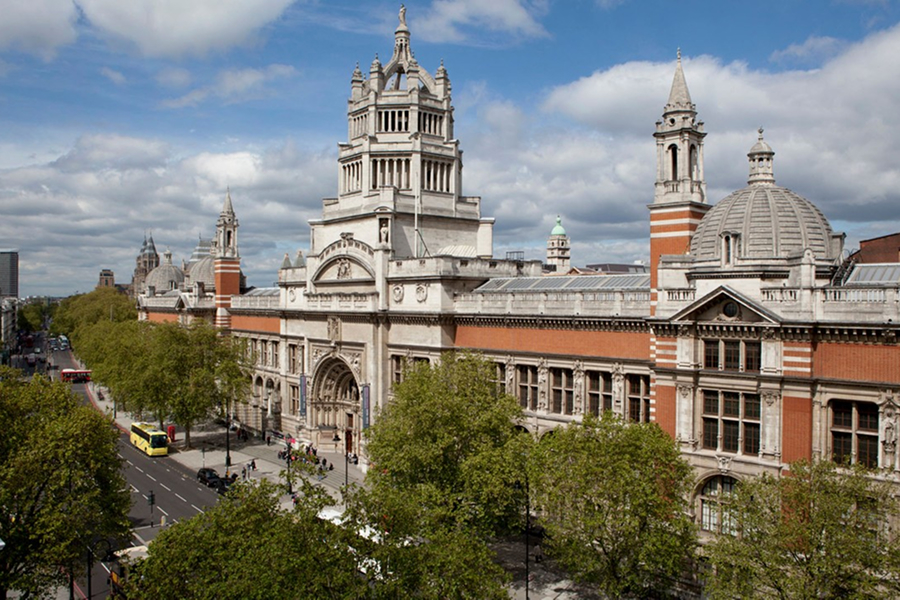


- Burberry opens a free exhibition at the Prince Consort Gallery from 21 September to 3 January, closing with 19 runway looks from Daniel Lee and Christopher Bailey.
- Van Cleef & Arpels is wrapping a four-month archival showcase of more than 40 pieces at its first Madrid boutique.
- The museum show has become a standard tool. It converts an archive from a storage cost into a working asset.
- It only works for houses with something verifiable in the vault, which is the whole point.
Luxury houses now stage exhibitions the way they once staged campaigns. Burberry opens a free display at the Prince Consort Gallery running from 21 September to 3 January, closing with nineteen runway looks from current and former creative directors including Daniel Lee and Christopher Bailey. Van Cleef & Arpels is completing a four-month archival showcase of more than forty pieces at its first Madrid boutique. These are not marketing events with an educational veneer. They are the most efficient way a house can prove a claim that advertising can only assert. Here is what the format actually does and which brands it excludes.
What an Exhibition Does That a Campaign Cannot
It substitutes evidence for assertion. A campaign says a house has heritage. An exhibition puts fifty years of it in a room and lets a visitor check.
Three mechanisms make it work:
- Third-party framing. Shown in a gallery or museum context, the objects are presented as cultural material rather than as merchandise. The institution lends its own credibility, and that transfer is the reason houses accept the loss of control that comes with a museum partner.
- Duration. A campaign runs for weeks. Burberry’s display runs for more than three months, and Van Cleef & Arpels held Madrid for four. That is a very different exposure profile for a similar budget.
- Proof of continuity. Showing nineteen looks spanning several creative directors demonstrates that the house survived each transition, which is exactly the claim a maison needs to make in a period when creative leadership changes every two or three years.
That third point is the sharpest. We set out in the creative director carousel that the compressed appointment cycle risks leaving houses without a recognisable aesthetic. An exhibition that hangs Bailey next to Lee is an argument that the house is the constant and the designers are the variables.
Three and a half months, free. The Burberry display runs 21 September to 3 January at no cost to visitors. Free admission changes who comes: it removes the filter that turns a brand exhibition into an event for people who already own the brand.
Why the Timing Is Deliberate
Burberry opening on 21 September places the exhibition immediately after London Fashion Week, which runs 17 to 21 September, and it stays open through the entire Christmas retail season into the new year.
That is a calendar decision doing two jobs. It captures the international press and buyer traffic already in London for the shows, and it then converts into a public attraction for the months when the city fills with visitors who are not fashion professionals.
The wider September circuit and what it is actually testing is set out in the September circuit.
Which Houses This Format Excludes
Most of them, and that is the reason it works.
An exhibition requires an archive: physical objects, documented, in condition, spanning enough time to constitute a narrative. A house founded in 2015 has nothing to hang. A house whose production was outsourced and undocumented has objects without provenance. A house that discarded its samples has a story it cannot evidence.
That exclusivity is precisely what makes the format valuable. Any brand can commission a campaign. Very few can open a vault, and the difference between the two is the difference between claiming heritage and having it, which is the distinction we draw in heritage brand strategy.
It also explains why jewellery houses have adopted the format faster than fashion ones. A necklace from 1935 survives in wearable condition. A dress from 1935 frequently does not, and textile conservation is a specialist discipline with real cost attached.
Brand exhibitions divide into two categories that look identical to a visitor. A house-funded show in its own or a rented space keeps full editorial control over the narrative. A genuine museum partnership cedes curatorial authority to the institution, which may include material the brand would rather omit. The second carries far more credibility for exactly that reason, and it is also slower to arrange and harder to steer. Reading which one you are looking at tells you how much of the story has been checked by someone other than the brand.
The Archive as an Operating Asset
Once a house treats its archive as a working resource rather than as storage, three uses open up beyond exhibitions.
- Product development. Reviving a documented model is lower risk than inventing one, and it is the pattern behind the strongest recent creative changes, where houses recovered something they already owned rather than inventing a position.
- Authentication and resale support. A documented archive lets a house verify its own pieces, which matters increasingly as the secondary market grows and as auction houses use collectibles to recruit younger buyers, a shift covered in how watches became the auction houses’ gateway.
- Machine-readable provenance. Catalogued and published archives feed the sources that generative assistants read when a client asks about a house. An undocumented archive is invisible to that layer entirely.
An exhibition is an audit a house chooses to publish. It works because the objects either exist or they do not, and a visitor can tell. For any maison considering the format, the useful first question is not what story to tell but what the vault can actually support, because the gap between the two is where credibility is lost.
Bottom Line
Burberry at the Prince Consort Gallery from 21 September to 3 January, free, closing with nineteen looks spanning Christopher Bailey and Daniel Lee. Van Cleef & Arpels closing four months of archival display in Madrid with more than forty pieces. The exhibition has become a standard instrument because it does something advertising structurally cannot: it produces evidence rather than assertion, over months rather than weeks, in a context that lends institutional credibility. It is also self-selecting, since it requires an archive that exists, is documented and survives in condition. For houses that have one, the archive has stopped being a storage line and become an operating asset. For those that do not, no amount of budget produces one retroactively. The foundations sit in what luxury branding actually means.
FAQ
When is the Burberry exhibition?
It runs from 21 September 2026 to 3 January 2027 at the Prince Consort Gallery, and admission is free. The display closes with nineteen runway looks from current and past creative directors, including Daniel Lee and Christopher Bailey, spanning several eras of the house.
Why do luxury brands stage museum exhibitions?
Because an exhibition produces evidence where a campaign produces assertion. Physical objects in a gallery context, viewed over months rather than weeks, prove continuity and craft in a way advertising cannot. Institutional framing also transfers credibility that a brand cannot generate on its own.
Do brand exhibitions actually sell anything?
Not directly, and the ones that try tend to fail. Their commercial function is indirect: they substantiate the claims that justify pricing across the whole range, and they reach an audience broader than existing clients, particularly when admission is free. Judging them on attributable sales misreads what they are for.
Can a young brand stage an archive exhibition?
Not credibly. The format requires physical objects, documented provenance and enough time span to constitute a narrative, none of which can be created retroactively. A young house can exhibit process, materials or collaboration, but an archive show requires an archive, which is precisely why the format carries weight.